Skip navigation

Category Archives: academia

This week’s post is a recap of an event in which I participated on Monday, April 2. It’s housed over at the blog of the organization that hosted the event, the venerable Unit for Criticism at the University of Illinois.

So please do head over there and check it out: Hack This Post! Contesting Technological Neutrality at Technology in Theory and Practice


You remember the game of Telephone from your childhood: kids whisper a message from ear to ear along a group of people, and when it gets to the end of the chain the last person says it out loud, hilariously garbled.

I had not, until this academic year as I’m starting to be less of an apprentice and more of an academic-proper, appreciated how much being in my line of work is quite a lot like being permanently engaged in Telephone.

I first saw it when I went to the Association of Internet Researchers conference this October. As any good Internet or media conference does in this day and age, AoIR had a hashtag (#ir12) and extensive livetweeting. And, I’ll admit that when I followed that stream, I paid particularly close attention to the tweets about my presentation—don’t pretend y’all don’t do that too.

The result was that, for the first time, I got to see my meaning escape my control as it happened. For someone who operates from somewhere in the Active Audience realm and is very committed to the idea that the author does not decide her own meaning, this shouldn’t have surprised me, but it was decidedly uncomfortable to have it happen to my own statements.

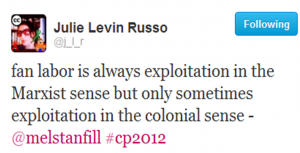
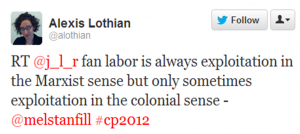
Unfortunately, I didn’t think to record the tweets in their entirety as they happened, but fortunately Fabio Giglietto of the Department of Communication Studies at the University of Urbino Carlo Bo put together a Storify collection for the conference that features some of the discussion about my talk. It went something like this:

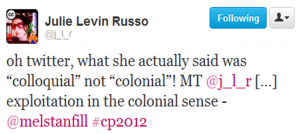
After my clarification, which was retweeted by @drst (whose real identity I know but she seems to not have it attached to her account), this reply came back:

This was, of course, a joking response, but it shows why it is that my statement, reduced to “fans are livestock” rather than “livestock is a useful metaphor,” was odd to people who got it second hand. Fans aren’t really livestock in a lot of senses—nutritional uses being one of them—but when it got retold the way it did people potentially got the idea that I’d said something far wackier than in fact I did.

Something similar happened after my article, Doing Fandom, (Mis)doing Whiteness: Heteronormativity, Racialization, and the Discursive Construction of Fandom appeared in Transformative Works and Cultures in November, though I didn’t see it until I Googled myself on a lark in January.

In TWC’s Symposium blog, Lisa Schmidt wrote an entirely appreciative post responding to my piece (called it “a really wonderful essay” and everything) in which—as in the AoIR example—she picked up on one of my points and did something with it that I didn’t intend.

Schmidt said: “The pressure of ‘normal’ is intense and maddening, which is why Stanfill’s section on fandom as a kind of queerness or sexual deviance resonated so powerfully for me. Supposedly fandom is becoming increasingly accepted by the mainstream yet, in many contexts, it remains a dirty little secret. It is a kind of closet, even for some who are in long-term relationships with persons of the opposite sex.”

Okay—so far that’s fine—”sexual deviance” isn’t that deviant from what I was trying to say, “closet” is right. But then things take a turn for the dead author: “More than ever, I feel that fandom, even when not explicitly having anything to do with anything sexual, is queer.”

This was the alarm-bells or record-scratch moment, because I was actually very careful NOT to say that fans were queer. In earlier drafts I had said so, but by this point I felt like it didn’t really capture what I was after. Instead, the terminology I was using was “nonheteronormative.”

The real trouble for my ability to control what people think I’ve said comes when people responded to Schmidt, for though she says “Of course, this is not really the point of Stanfill’s article,” this still becomes what is picked up on in the comments to her post.

User Havoc replied:

I feel like making everything queer dilutes the problems that actual queer folk can go through. Fans don’t need laws changed to be married to fans of the opposite gender, so long as they meet the gender binary. I feel that to list all fans as queer is appropriative of actual queer identity.

Yes, let’s avoid the idea of whiteness as the norm for fans (and elsewhere). But let’s also try not to appropriate one group’s struggles and make them universal to fandom, because LGBTQ struggles aren’t fandom struggles (unless they’re intersectional and both a fan and LGBTQ), and it’s not fair to those who identify as LGBTQ.

And Dana Sterling added: “I tend to agree with havoc about feeling like using queerness in this way in regard to fandom borders on appropriative.”

It was these responses that really distressed me. First, there was the suggestion that sexuality is only “LGBTQ” people’s problem (the phrase “unless they’re intersectional,” the identification of struggles as the essential property of “actual queer folk”). Then there was the reduction of sexuality-based inequality to the denial of state-sanctioned marriage. Moreover, I am heartily sick of reducing queerness to pain.

However, the biggest source of frustration for me was largely because all of these positions I find so problematic are actually incompatible with what the article is trying to do.

Queer, as an analytical apparatus, doesn’t actually describe the way fans work in culture, and so I didn’t use it. It also carried the danger of exactly the interpretation of fandom-as-oppressed-sexual-minority that these retellings and responses produced, something I would never want to argue because it’s patently absurd—though not because I’m worried about “appropriating” any oppression supposedly endemic to queers.

I suppose I’m going to have to get used to this—I’m going to continue to publish, and I really want to be that bigshot academic everybody talks about. Unlike the Twitter example, I can’t always go rushing in to correct those misperceptions as they occur. So I guess we’ll have to add “telephone distortion” to the occupational hazards of being an academic like eyestrain, carpal tunnel, and atrophy of the social life.

Though theoretically this blog is a place to preview things I’m working on, it hasn’t ever been so far. However, in a week when no current events or pop culture topics stand out to me (though as Bradley Manning’s Gender Identity Disorder defense broke this morning, too late to blog, I was nevertheless tempted), and I’m going to be traveling on Blog Thursday anyway, I thought I’d give it a go.

I’ve recently finished reading two very smart dissertations, Julie Levin Russo‘s Indiscrete Media: Television/Digital Convergence and Economies of Online Lesbian Fan Communities and Suzanne Scott‘s Revenge of the Fanboy: Convergence Culture and the Politics of Incorporation.

These are scholars I personally know and respect and thinkers after my own heart. So much after my own heart, in fact, that my reading of their dissertations was punctuated by bouts of fear that one or the other of them—or both!—had already written what I wanted to say in mine.

Both are interested in the interface of fandom and industry, like me. They are wary, rather than uncritically enthusiastic, about the impact of digital technology, like me. They are concerned about the role of capital in contemporary fandom, especially as labor—like me. Among the objects in all three dissertations is Battlestar Galactica’s website and video maker. That’s a lot in common.

And, I suppose I could look at it as: If three dissertations, produced across the country (East Coast, West Coast, Midwest), with no more than minimal collegial interaction (like, I had already planned to look at certain issues before I got around to doing this reading, and we haven’t really discussed it—maybe Julie and Suzanne were in closer touch), are doing this work, then maybe that means it’s just time for these questions to be asked.

But I don’t entirely have the luxury of just celebrating the fact that other people have noticed the things I care about. The scholarly project, as currently defined in the U.S. anyway, is to produce something new, that no one has said, and differentiate it from what people have said before. For my dissertation to be seen as valid, then, it has to be different from Julie and Suzanne, so when those moments of “OMG, she wrote my dissertation!” came over me, I would take a moment to figure out how I differed.

Here’s what I came up with.

I am, first, way more of a Foucaultian than either of them. What I find interesting about contemporary practices of “embracing” fandom (or, at least, how I frame it) is the way that the waning of repressive power—saying “no” through cease-and-desists, say—looks like no power at all. But of course it still is power. It’s just productive power—inciting and normalizing certain behaviors and practices, and in so doing producing fandom.

To those whose behavior is incited and within the norm, it looks like a free-for-all, but at the margins—often produced through gender (Scott) and sexuality (Russo)—the seams show. We scholars can see around the edges, then (and so can some fans, to provisionally accept a standpoint, “the oppressed can see the system better” argument that I’m not sure I totally buy).

Recognizing, then, that what’s in that middle, normative space is constructed and partial and benefits industry/capital way more than fans, if the cultural status of fandom has shifted in the internet era, what is it now? How does mainstream American culture make sense of this concept “fan”?

When we see fans on our television or cinema screens, who are they and what do they do? If they’re no longer automatically murderers (which I’ll be the first to admit is an improvement), that doesn’t mean that what they are now doesn’t matter—so what’s the meaning of this concept that we see representationally constructed?

When industry extends a hand to fans, who do they reach out to? What do they invite them to do? What do they think a fan is? And, with the much-vaunted capacity of the internet to make things possible, what actually becomes a possibility? When industry invites fans to come play, what does that consist of? What do official websites afford or not afford, and how is that implicitly an argument about who fans are and what they do?

Rather than looking at specific texts or cultures of fandom, as Russo and Scott do (exceedingly well), my aim is to assess the cultural field of meaning surrounding the idea “fan” by tracing how it gets deployed across the mediascape in fictional and nonfictional representation and by industry in web design and their own conceptualization of the term.

And rather than asking how industry practice matches up (or doesn’t) to existing fandoms, I turn the question a different direction: With this productive power, what is “fan” being produced as?

And that seems different enough, and to produce enough of a different set of knowledge, to be worth doing despite the great things that have already been done.

In her opening remarks on the conference’s first day, outgoing Association of Internet Researchers president Mia Consalvo said that the conference was like a family. And, being used to massive conferences like the National Communication Association where anyone less famous than God or the Beatles gets lost in the crowd, I rolled my eyes a little. But as I’m here longer, I’m starting to think she was right.

Point 1: I had lunch with a complete stranger yesterday. Now, I’m one of the least social humans on the planet. I. Do. Not. Like. Strangers. But there I was, at the info desk asking the concierge about where to eat at the same time as someone else, and we just decided to go together. And it was a totally great experience, and I have to think there’s something about the culture of the conference that made that possible.

Point 2: I went up to a scholar after her panel to ask if any of her students might be interested in publishing in the special issue of Transformative Works and Cultures I’m guest editing, and she not only handed a copy of the CFP to her student but took one for herself. Maybe my expectations are really low from a number of bad experiences with Big Name Scholars (who shall remain nameless), but she totally treated me like a worthwhile human being!

Point 3: A professor from my university, who a) isn’t in my department and b) isn’t even on my committee (but who was my professor for a class once, two years ago) came up to me at the reception and asked who she could introduce me to. Faculty just don’t do that kind of stuff in my experience up until now. Don’t get me wrong; the professors in my department are amazing and will totally promote the bejeezus out of us, but we have to ask them.

And, it’s not related to the “professional organization as family” part, but I have really never been at a conference where so many of the people I see walking around are people whose work I not only know but admire. This indicates, I think, that this is the right kind of place for me to be hanging out.

This is all to say: I less than three AoIR! And I will be back any time it’s someplace I can afford to fly!

Addendum, October 13: The moderator for my panel carried my bag into the elevator when I didn’t have enough hands to wrangle it + breakfast, cuz she’d read my post and wanted to make sure I kept feeling welcome.

Among the hats I wear, I’m an educator. I’m also someone who already has one postgraduate degree and is working on another. So when Laura Pappano of the New York Times discussed “The Master’s as the New Bachelor’s,” it hit close to home on a couple of fronts.

I first became aware of the upward push of credentialing when one of my students, not a particularly hardworking or brilliant one, mentioned that he was thinking of going to grad school. Thinking that maybe he was a nonmajor who was actually a smart and involved student in his home discipline, I asked him “In what?”

His reply? “I don’t know, but you have to have a master’s to get a job these days.”

This was immensely irritating to me, because he seemed all ready to go to grad school without having the slightest sense of how it works—even something so basic as the fact that it doesn’t work like undergrad where you figure out your major later. And, honestly, it offended me a little personally, since it felt like a lack of appreciation for my education.

But thinking back to that master’s degree of mine, maybe I should have been aware sooner that lots of people go to grad school in a way that feels to me like not really meaning it. Most of the people I went to school with, in fact, weren’t planning to be academics.

Particularly for the students in their early 20s, many of them were just used to being students and kept going. Or they wanted to have more time to figure out what they wanted to do with themselves. For this kind of master’s student, grad school was a place to take a time out on growing up.

This probably sounds patronizing, but it’s not. Just because I knew I wanted to be an academic as soon as I got over my teen-angst desire to be a poet in a garret (so, like, when I was 18?) doesn’t mean everybody is as certain about their path, as evidenced by the wide range of ages among my colleagues in my PhD program. If you don’t know where you’re headed, it’s definitely better to pull over than to keep driving.

Another subset of my MA colleagues had, in the snarky-fabulous words of a friend,

a very narrow interest in one subject and they saw getting a sociology degree as a conduit to being able to study the subject that they really cared about personally. Those were the students who were totally disengaged in all of our classes because they really only wanted to study that single thing and instead, they got stuck with 2 huge books of Weber or Bourdieu or Foucault.

And I do think that desire to study a particular thing is valid, even if I’m not sure getting a master’s degree is the right way to go about it.

However, quite a few of the students in my MA classes just wanted to have a piece of paper that showed they were smarter or more dedicated than a BA because, as the NYT article suggested, that’s not enough anymore. In the communication department, for example, one was an office worker—I think maybe an HR manager?—trying to improve her options by getting a master’s with a focus in organizational communication.

This last group I find troubling. I feel like there are things you legitimately need a master’s degree to do, but there are also all kinds of things you don’t, and you shouldn’t get one just to get one, particularly since student loan debt never, ever, EVER goes away even if you declare bankruptcy.

I mean, seriously, there are things you don’t even need a bachelor’s degree to do. We need plumbers and roofers and all kinds of other tradespeople, and those are jobs that are way too important to be as socially devalued as they are. That’s a problem. That’s a place where we need a cultural intervention to change how we think about those careers.

Additionally, a surprising number of young adults who really aren’t cut out for academics feel compelled to get a college degree anyway. Which also might sound patronizing, but I don’t mean to say that these students aren’t bright; what I mean is that there are different ways to be smart and we’re increasingly tending to put everyone into only one box labeled Bachelor of Arts (or Sciences). Again, here’s a site where an intervention is sorely needed.

These are complex issues that have, I’m sure, inspired voluminous publication among researchers of education. They deserve careful, measured attention beyond what I’ve got to give to a blog entry. I’m no expert, and the question of college becoming de facto compulsory affects broad swaths of the population—not least those who don’t go and then find their possibilities radically curtailed.

If the expectation of universal college degrees is a First World Problem, degree inflation to the master’s is definitively a Bourgie People Problem. However, even though wealth does not “trickle down,” norms and the hoops one has to jump through to succeed do. This means that, just as college went from being middle class to being the ticket to the middle class, the master’s degree may well follow suit.

Eric A. Hanushek, whom the NYT piece describes as “an education economist at the Hoover Institution,” argues that “We are going deeper into the pool of high school graduates for college attendance,” which makes a “bachelor’s no longer an adequate screening measure of achievement for employers,” and I find this incredibly telling.

Hanushek means to make an argument about the students who are not in the top 10 or 25 (or maybe even 50) percent of their high school class, such that people who get college degrees aren’t only the spectacular students anymore.

However, that class rank correlates quite strongly with other categories in a way that matters. The kids at the top, who traditionally had access to professional jobs, are disproportionately middle class and white, but now the college pool is expanding beyond those privileged categories.

That means that, whereas once the B.A. separated out the middle class kids from the working class ones, that’s no longer true now that everyone’s going to college. The rush to the M.A. begins, then, to seem a bit like “OMG, poor kids are getting bachelor’s degrees! Better raise the bar!”

As the Times article says, “browse professional job listings and it’s ‘bachelor’s required, master’s preferred,’” and it makes me wonder whether what they really mean is “upwardly mobile required, middle-class preferred.”

Hanushek argues that there’s “some devaluing of the college degree going on,” which makes the master’s more valuable as an indication of ability. As Pappano argues, “perhaps all this amped-up degree-getting just represents job market ‘signaling’ — the economist A. Michael Spence’s Nobel-worthy notion that degrees are less valuable for what you learn than for broadcasting your go-get-’em qualities.”

This devaluing of the B.A. and signaling ability with the M.A., then, is a trend that’s likely to continue. After all, as the Times article pointed out “Nearly 2 in 25 people age 25 and over have a master’s, about the same proportion that had a bachelor’s or higher in 1960,” and that’s probably not a historical coincidence as much as an indication that the former will follow the latter’s trajectory.

So, who knows? Give it 50 years, and we might well be having this conversation about the PhD. (Though the life expectancy for when I was born has me dying sometime around 2058, so I might not be around to see it.) That aspect of history repeating itself means that Hanushek may then be less hyperbolic than he intended when he quipped that “in 20 years, you’ll need a Ph.D. to be a janitor” as part of his condemnation of “credentialing gone amok.”

Now, as I said above, there are things you legitimately need master’s degrees to do. Generally, those are professional degrees: the MBA is helpful in learning how to run a business, the MSW helps you be a social worker, the MFA is good for being an artist or architect. The degrees that are proliferating are variations on these degrees: a “master’s in public history (for work at a historical society or museum), in art (for managing galleries) and in music (for choir directors or the business side of music).”

That is, there seems to be something of a “shift of graduate work from intellectual pursuit to a skill-based ‘ticket to a vocation.’” Pappano is pretty critical of this: “What’s happening to academic reflection? Must knowledge be demonstrable to be valuable?” she asks. “Or have we lost the ability to figure things out without a syllabus?” I am sympathetic to this, as this has been my gut reaction—to my student, and to my M.A. colleagues.

But, upon further reflection, if these degrees mean we can stop the professionalization of the bachelor’s, I might be in favor of it. That is, there’s an increasing push to turn the undergraduate curriculum into a factory for white-collar workers. There’s a tendency toward teaching students “skills” that they can immediately apply in the jobs they (apparently won’t) get after graduation.

But college is a time to learn how to think. Not what to think, despite the exactly one student evaluation form every semester concerned that I am “too liberal,” but how.

As the product of a really good undergraduate education (Cal has consistently been somewhere in the top 5 in the world in the numbers I have. And, we beat Stanford in 2010. Go Bears!), I had a leg up on people I encountered when I worked in the business world.

Yes, I walked into my first office job without specific knowledge about business, but I knew how to think critically and ask questions, which ended up serving me pretty well and maybe actually being the “skill” set I needed to work that professional job after all, despite the tendency toward vocationalization.

That’s what we owe undergraduates. To extend the platitude, it’s not to give them a fish, but it’s also not to teach them how to fish. We have to teach them how to figure out how to fish. It’s second-order. Or maybe third-order. Something. And if they then want to go and get specific skill training in a master’s degree instead of doing research, I suppose I can be down with that.

As long as I get an asterisk next to mine that shows I did do research.